


School Party Craft
Candy Room Games & RabbitCo
School Party Craft is the kind of adventure game I open when I want something light, colorful, and easy to understand within a few minutes. Its setting turns school life into a playful fashion-and-social playground, aimed at children and teenagers rather than players looking for difficult combat or a serious story. I found the appeal less in reaching a dramatic ending and more in making a character look right, exploring the school-themed world, and creating another small scene to enjoy.
That makes it a very different experience from a traditional adventure game. There is no need to memorize complicated controls before having fun. The first useful action is usually simple: choose a look, move through the environment, and see how the character fits into the scene. The game then gives me a reason to adjust something, try another outfit, or begin a fresh fashion idea. The real hook is the short creative loop, not a demanding campaign.
How the school-fashion loop works
The first action is easy to understand
When I start playing, I do not feel pushed into a long tutorial or a complicated objective. The school setting immediately tells me what kind of mood to expect: casual, social, and focused on appearance. I can approach it as a dress-up game with movement, or as a small adventure space where changing the character is part of exploring.
Related News

That first choice matters because the game’s enjoyment begins before any larger goal appears. I might create an outfit for an ordinary school day, choose something more attention-grabbing for a party atmosphere, or simply experiment with combinations that would never make sense together in real life. The freedom is useful for younger players because it rewards curiosity rather than precision.
I also like that the basic premise is immediately readable for someone who has never played it. A child can understand the idea of preparing a character for school or a fashion party without needing a detailed explanation. An older player may enjoy it as a relaxed creative toy, especially when they want a break from action-heavy adventure games.
Related News

Why WhatsApp Messenger Still Makes Everyday Communication Feel Easy

Jurassic World: The Game Is the Better Dino Tycoon for Strategic Players

Threads in Real Life: Who Should Join, Lurk, or Leave

How SHEIN Turned Shopping Into an Endless Content Feed

How to Make Fortnite Feel Smarter on Mobile

Should You Switch to Microsoft Outlook on Mobile?
The trade-off is that the opening simplicity does not automatically develop into a deep mission structure. If you expect a long story with carefully staged discoveries, this will feel modest. The game works better when I treat each session as a small activity: make a visual choice, look at the result, move around, and decide whether I want to improve the scene.
Feedback comes from seeing the result
The strongest feedback is visual. I make a clothing or style decision, then immediately see how the character looks in the school environment. That quick response is important because it keeps the game from feeling like a menu-only dress-up tool. The character exists in a setting, so the outfit has a little context instead of appearing in isolation.
This is where the adventure category helps. Moving through the world gives the fashion choices somewhere to live. I can imagine a particular look for a classroom visit, a social gathering, or a casual walk around the school area. Even without a complex objective, the setting encourages me to ask what kind of character I am creating and where that character belongs.
Gallery
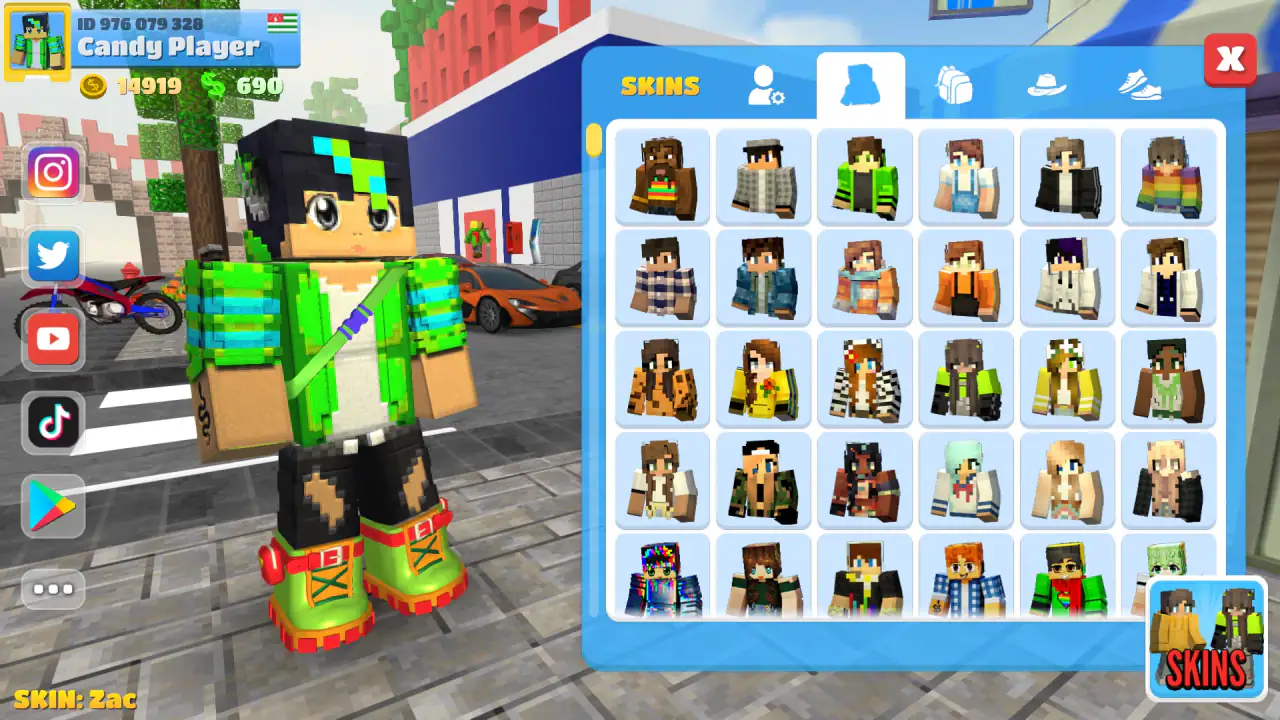
A useful approach is to make one deliberate change at a time. If I alter everything at once, it becomes difficult to understand which choice improved the look. Changing one part, observing the result, and then deciding whether to keep it creates a more satisfying rhythm. This is especially helpful for children who are learning to compare colors, styles, and overall balance.
There is also a practical benefit for short play sessions. Because the result appears quickly, I do not need a large block of free time to enjoy the game. It can fit into a quiet moment after school, while waiting for someone, or during a relaxed break. I would not use it when I want intense challenge, but I can easily see why a player might return to it for a few minutes at a time.
Rewards are creative rather than competitive
The reward in School Party Craft is mainly the finished look and the feeling that I have created a character with a particular personality. That is a different kind of reward from collecting powerful equipment or defeating a difficult enemy. The satisfaction comes from recognition: I see a combination that works, or I discover an amusing style that I want to keep looking at.
This makes the game approachable for players who are not interested in competition. A child can play without worrying about being slower than another player, while a teenager can use the game to test fashion ideas in a harmless, colorful setting. It also gives parents a clearer sense of the game’s tone: the focus is on playful presentation and school-themed imagination.
My tip is to start with a simple theme instead of trying to make the most unusual outfit immediately. A “first day at school” look, a party outfit, or a deliberately mismatched style gives the session a small creative target. Once that target is complete, experimenting becomes more enjoyable because I have something to compare it with.
The limitation is that creative rewards depend heavily on the player’s own imagination. Someone who needs constant unlocks, missions, or measurable progress may quickly feel that the game is not giving enough direction. It is better suited to players who enjoy making choices for their own sake than to players who need every action to produce a clear achievement.
Why another session begins
The reset is simple: I finish looking at the current character or scene, decide that another combination might work better, and start changing things again. That reset is not a failure state. It is closer to reopening a sketchbook and trying a new design. The previous attempt gives me a reference point, while the next one offers a chance to create a different mood.
This explains why the game can feel repetitive and inviting at the same time. The actions are familiar, but the purpose changes with each attempt. One session may be about making a neat school outfit; the next may be about creating something funny or dramatic. The game does not need a complicated reset system because the player supplies the new objective.
In an everyday situation, I could imagine handing the device to a younger sibling during a quiet afternoon. They might spend a few minutes making a character, show the result, then immediately decide that the character needs a different style. That cycle is naturally shareable. It creates conversation without requiring the other person to understand a complicated game world first.
For older players, the reset can be less compelling if there is no personal interest in dress-up or casual exploration. I would skip it if my main goal were a story with memorable dialogue, a challenging puzzle structure, or a competitive multiplayer experience. Those expectations point toward different kinds of adventure games.
Exploration gives the outfits context
The school theme is more effective than a plain character-customization screen because it gives the player a recognizable social setting. Clothes feel connected to a situation: a normal school day has a different mood from a fashion party, even when the activity remains relaxed. That context helps me make choices with a little more intention.
I recommend treating the environment as part of the styling process. Instead of choosing an outfit first and ignoring the setting, I can look at the scene and ask what kind of character would fit there. This small change in approach makes the experience feel more like creating a scene than merely selecting items from a wardrobe.
That is one of the game’s less obvious strengths. It can encourage storytelling without demanding that the player write a story. A character’s appearance, location, and imagined purpose combine into a tiny narrative. For younger users, this can support pretend play; for older users, it offers a low-pressure way to experiment with visual ideas.
Still, the school-party concept will not appeal equally to everyone. Players who prefer fantasy quests, realistic simulation, or fast combat may see the setting as too narrow. The game is at its best when the school environment feels like a stage for fashion and playful exploration, not when it is judged against a large open-world adventure.
What the technical details mean in practice
School Party Craft is free, which makes it easy to try before deciding whether its relaxed loop suits you. It is listed for Everyone 10+, so I would still encourage parents to look at the game themselves and decide whether the style and play experience fit their child. The game comes from Candy Room Games & RabbitCo, a developer associated here with this colorful school-themed experience.
The game was released on February 2, 2018, and the current version is 1.8.10. It supports Android devices running version 5.0 or later. That broad compatibility is useful for families using older phones, although actual smoothness can still depend on the individual device. I would close other demanding apps first on an older phone and keep expectations realistic about performance.
Its scale is clear from the audience response: it has an average rating of 4.5 from around 1.8 million ratings, with roughly 20 thousand written reviews and over 100 million installs. Those figures suggest that the basic idea has reached a very large audience, but popularity should not be confused with depth. A highly accessible dress-up adventure can be widely enjoyed while still feeling limited to someone seeking a complex progression system.
Because it is free, the sensible way to judge it is by the first few sessions rather than by expecting the scope of a premium adventure. If the quick visual feedback makes you want to keep redesigning the character, it has done its job. If you are waiting for a more demanding objective to appear, the game may not change your mind after extended play.
Who will enjoy it most
I would recommend it to children and teenagers who enjoy fashion, school settings, character creation, and imaginative play. It is also a reasonable choice for a parent looking for something more relaxed than a fighting game or an intense competitive title. The controls and central idea are approachable, and the player can set a personal goal without being forced into a difficult challenge.
It can also work for casual players who like making small visual projects. I found the best sessions were not the ones where I tried to play for a long time. They were the ones where I chose a theme, made a few adjustments, looked at the result, and stopped when the idea felt complete.
I would be more cautious about recommending it to someone who wants a strong narrative. The school-party premise creates atmosphere, but it should not be mistaken for a story-driven adventure with deep character development. Likewise, players who want constant progression may prefer a game built around missions, levels, or competitive goals.
Compared with a standard dress-up app, this game benefits from putting the character into an adventure-like school setting. Compared with a conventional adventure game, it offers much less pressure and fewer reasons to master difficult mechanics. That middle position is its identity: more active and contextual than a static wardrobe, but gentler and less structured than a quest-focused game.
Small habits that improve the experience
My first practical suggestion is to decide the purpose of the outfit before choosing individual pieces. A clear idea prevents random tapping from becoming the entire session. Even a simple theme such as “school morning” or “party guest” gives the choices direction and makes the final result easier to judge.
Second, use the reset deliberately. Do not assume that changing everything is the only way to make a new design. Keep the main idea and alter one visible element, then compare it with the previous version. This turns repetition into a basic design exercise and helps younger players notice how small changes affect the whole appearance.
Third, play in short creative bursts if the game starts to feel repetitive. The loop is strongest when it remains a quick activity rather than a long obligation. A short session also makes it easier to return later with a new idea instead of exhausting every possibility at once.
Finally, share the result with someone nearby if that is practical. The game’s social feeling does not require a complicated online competition. Showing a finished character to a friend or family member can provide the extra feedback that the simple game structure does not always supply on its own.
My verdict on the action-feedback-reset cycle
School Party Craft succeeds because its loop is easy to enter: make a style choice, see the character in a school-party setting, enjoy the result, and begin again with a new idea. The feedback is immediate, the reward is creative, and the reset feels natural rather than frustrating. That combination explains why the game can be appealing in short sessions even when it does not offer the depth of a traditional adventure.
My honest reservation is that the same simplicity can become a ceiling. If the player does not enjoy fashion experimentation or inventing personal goals, there may not be enough structure to maintain interest. I would choose a more story-led adventure for exploration, a puzzle game for mental challenge, or a competitive title for measurable victories.
For the right audience, though, this free game is an inviting little playground. It gives children and teenagers a colorful way to combine school-themed exploration with personal style, while remaining approachable for casual players. My recommendation is to try it when you want a relaxed creative session, not when you are searching for a demanding adventure campaign. That is where its action, feedback, reward, and reset cycle feels most convincing—and where another session begins for a good reason.
FAQs for School Party Craft
What is School Party Craft and what can I do in the game?
School Party Craft is a vibrant sandbox simulation game that combines elements of building, crafting, and social interaction. Players can explore a school-themed environment, build their own houses, and engage in various mini-games. The game provides a platform for creativity and social engagement, allowing players to interact with others in a virtual school setting.
Is School Party Craft suitable for all age groups?
School Party Craft is designed for a wide audience, particularly appealing to younger players who enjoy creative and social gameplay. The game features a colorful and friendly environment, making it appropriate for children. However, parental guidance is recommended for younger players to ensure a safe and secure gaming experience.
What are the main features of School Party Craft?
The game offers a range of features including customizable avatars, building and crafting tools, and interactive mini-games. Players can design and furnish their own homes, participate in school events, and socialize with other players. The game also includes a variety of outfits and accessories to personalize avatars, enhancing the immersive experience.
Does School Party Craft require an internet connection to play?
Yes, School Party Craft requires an internet connection to access all its features, particularly the social interaction elements. An online connection allows players to participate in multiplayer events, interact with other players, and receive regular updates and new content. Offline play is limited in terms of available features and gameplay.
Are there in-app purchases in School Party Craft?
School Party Craft includes in-app purchases, offering players the option to buy virtual currency and cosmetic items. While these purchases can enhance the gaming experience by unlocking additional content and customization options, they are not necessary to enjoy the core gameplay. Players can still enjoy the game fully without spending real money.
Pros
- Engaging 3D graphics for immersive play.
- Customizable avatars enhance personal expression.
- Variety of activities keeps gameplay fresh.
- Multiplayer mode fosters social interaction.
- Frequent updates with new content.
Cons
- In-app purchases can be costly.
- Occasional connectivity issues in multiplayer.
- Ads can interrupt gameplay experience.
- Limited offline play options.
- Some features require high-end devices.


